Search is changing. More and more questions are now answered directly by AI: Google AI Overviews and AI Mode at the top of the results, and tools like ChatGPT and Perplexity for everything else. Business owners are asking a fair question: how do I rank in AI Overviews and get mentioned in AI answers?
The good news is that it is less mysterious than the hype suggests. Here is what Google officially says, what actually helps, and which “AI SEO” tricks you can safely ignore.
What Google officially says
Google has published clear guidance on AI features and your website. The key line:
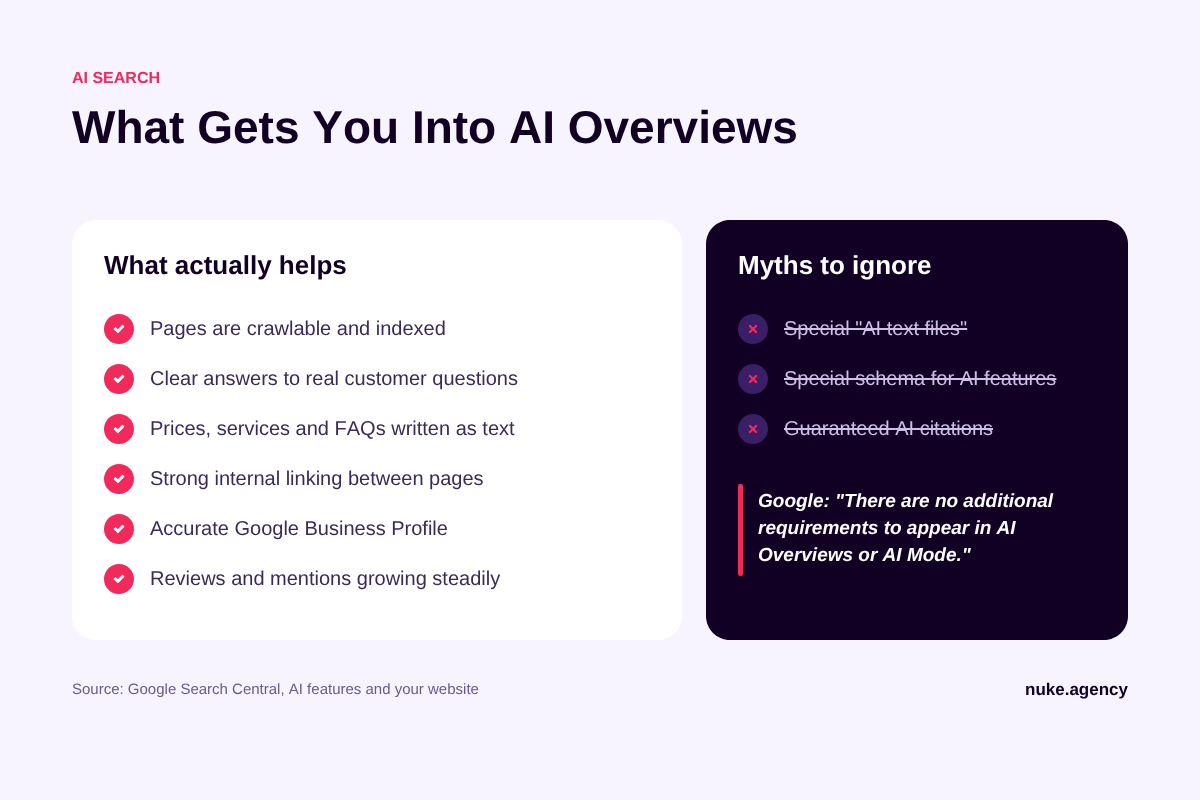
“There are no additional requirements to appear in AI Overviews or AI Mode, nor other special optimizations necessary.”
To be eligible, a page simply needs to be indexed and eligible to appear in Google Search with a snippet. In other words, the foundation of AI visibility is solid, normal SEO.
Google also says you do not need to create special “AI text files,” new machine-readable files, or special schema markup for these features.
What actually helps you appear in AI answers
1. Make sure Google can crawl and index your pages
If Googlebot cannot reach a page, it cannot be shown anywhere, including AI Overviews. Check that robots.txt, your hosting, or your CDN are not blocking crawlers, and verify your site in Google Search Console to catch indexing problems.
2. Answer real questions clearly
AI answers pull from pages that explain things well. Structure your content around the actual questions customers ask:
- Use descriptive headings that match the question
- Give a direct answer in the first sentence or two
- Then add detail, examples, and context
This is exactly how this article is written.
3. Keep important content in text
Information hidden inside images, PDFs, or scripts is harder for search systems to use. Put your key details, such as services, prices, locations, and FAQs, in plain HTML text on the page.
4. Show real expertise
Content written from actual experience stands out: specific numbers, real examples, original photos, and clear authorship. Thin, generic content that says what every other page says has little reason to be cited.
5. Use internal links
Google recommends making content easy to find through internal links. Link related pages together so both people and crawlers can follow the topic.
6. Keep your Business Profile and structured data accurate
For local businesses, Google specifically mentions keeping your Business Profile information current. If you use structured data, it must match what is visible on the page.
7. Build your reputation off-site
AI tools often summarize what the wider web says about a topic or brand. Reviews, mentions in reputable publications, directory listings, and links from relevant sites all strengthen how often and how positively your business shows up.
What about ChatGPT, Perplexity and other AI tools?
There is no official “ranking guide” for most AI chat tools, so be skeptical of anyone selling guaranteed placement. What we can say is that many AI tools that browse the web rely on search results and well-known sources. The same fundamentals apply:
- Be crawlable and indexable
- Publish clear, genuinely useful answers
- Be mentioned and linked by credible sites
- Keep your business information consistent across the web
AI SEO myths to ignore
- “You need an llms.txt or special AI file.” Google says no special files are needed for its AI features.
- “Special schema will get you into AI Overviews.” Google states there is no special structured data for these features.
- “AI killed SEO.” AI answers are built on top of search. Good SEO is the entry ticket.
- “We can guarantee you will be cited.” Nobody controls what an AI system includes in a given answer.
How to measure AI search traffic
Google includes traffic from AI Overviews and AI Mode in the Search Console Performance report under the “Web” search type. Pair that with Google Analytics so you can track whether visitors actually turn into leads and customers. Google also notes that clicks from AI Overviews tend to be higher quality.
A simple AI visibility checklist
- ☐ Site verified in Google Search Console
- ☐ Key pages indexed with no crawl blocks
- ☐ Service pages answer real customer questions
- ☐ Prices, locations and FAQs written as text
- ☐ Related pages internally linked
- ☐ Business Profile complete and current
- ☐ Reviews and mentions growing steadily
Frequently asked questions
Does AI mean I should stop investing in SEO?
No. Google’s own guidance makes standard SEO the requirement for appearing in its AI features. Skipping SEO now means being invisible in both classic and AI results.
Can I block AI from using my content?
Yes. Google offers controls such as nosnippet and max-snippet, and the Google-Extended token for limiting use in other Google AI systems. Blocking can also reduce your visibility, so weigh it carefully.
How long does it take to show up in AI Overviews?
There is no fixed timeline. Pages that already rank well and answer the question clearly are the most likely to be used.
Get your business ready for AI search
NUKE builds SEO strategies that work for both classic search results and AI answers: technical fixes, question-led content, and reputation building. Explore our SEO services, see pricing, or book a free audit.
Running ads as well? Read Google Ads vs Facebook Ads for small businesses.