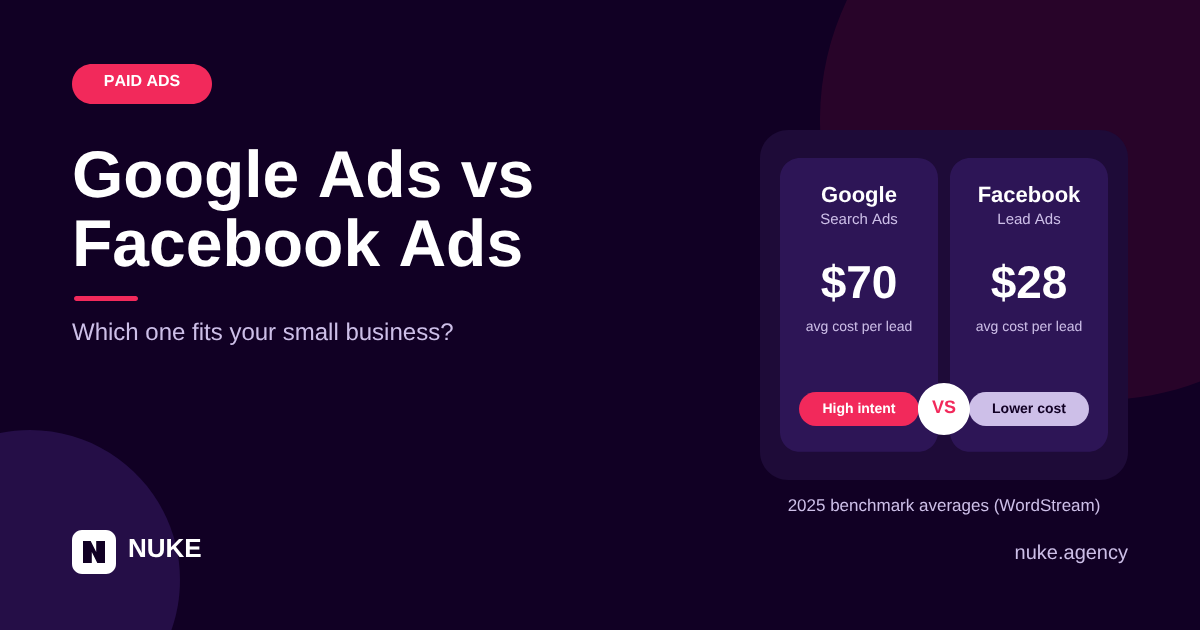
If you have a limited ad budget, you want every dollar working hard. The usual debate is Google Ads vs Facebook Ads. Both can work brilliantly, and both can burn money fast. The right choice depends on how your customers buy.
Here is a practical comparison using recent benchmark data, plus a simple way to decide.
The core difference: demand capture vs demand creation
- Google Ads captures demand. People are actively searching for what you sell, for example “emergency plumber near me.” You show up at the exact moment of need.
- Facebook Ads (Meta) creates demand. People are scrolling, not searching. You interrupt them with something interesting enough to stop the scroll, based on who they are and what they like.
That one difference explains almost everything else: cost, targeting, and the type of creative that works.
What the numbers say (2025 benchmarks)
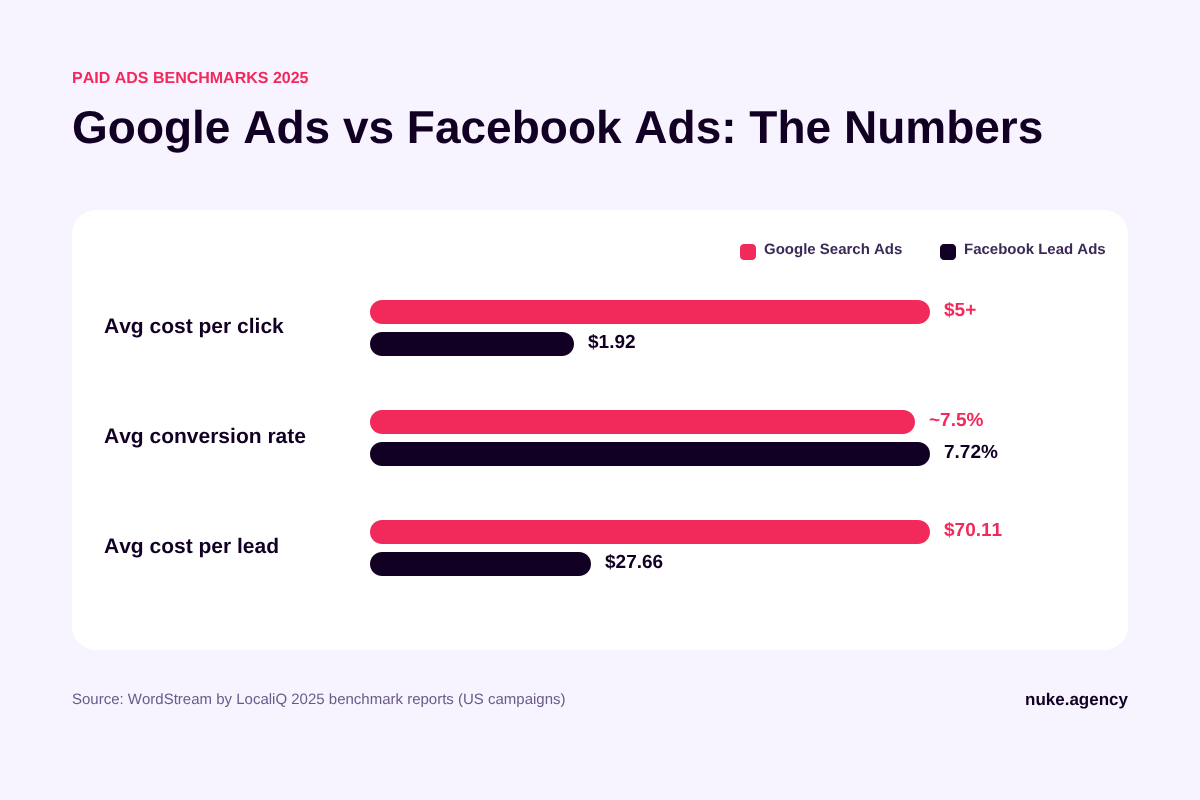
WordStream by LocaliQ publishes annual benchmark reports based on thousands of real campaigns. Their 2025 data shows:
| Metric | Google Search Ads | Facebook Lead Ads |
|---|---|---|
| Average cost per click | Just over $5 | $1.92 |
| Average conversion rate | Around 7.5% – 8% | 7.72% |
| Average cost per lead | $70.11 | $27.66 |
Sources: Search Engine Land coverage of WordStream’s 2025 Google Ads benchmarks and WordStream’s Facebook Ads benchmarks 2025.
On paper, Facebook leads look much cheaper. But a cheaper lead is not always a better lead. Someone who searched “roof repair cost” this morning is usually much closer to buying than someone who filled out a form while scrolling at night.
When Google Ads is the better choice
- People already search for your service. Plumbers, dentists, lawyers, locksmiths, accountants, and most local services.
- Urgent or high-intent needs. If customers need you today, search is where they look.
- High-value services. A $70 lead is cheap if a new client is worth $3,000.
- You want predictable, measurable leads. Search campaigns are easier to tie to calls and form fills.
When Facebook Ads is the better choice
- Visual products or experiences. Fashion, food, home decor, fitness, travel, events.
- New or unusual products that people do not yet know to search for.
- Lower-priced products and impulse purchases.
- Retargeting. Showing ads to people who already visited your website is often one of the most profitable campaigns you can run.
- Building awareness in a specific local area or audience.
Side-by-side comparison
| Factor | Google Ads | Facebook Ads |
|---|---|---|
| User intent | High (actively searching) | Lower (browsing) |
| Targeting | Keywords and location | Interests, demographics, behaviors, lookalikes |
| Best creative | Clear, relevant text ads | Scroll-stopping images and video |
| Cost per click | Higher | Lower |
| Lead quality | Usually higher | Varies; needs good follow-up |
| Time to results | Fast | Fast, but creative testing takes time |
Can you use both?
Yes, and many small businesses should. A common and effective setup:
- Google Search Ads to capture people actively looking for your service.
- Facebook and Instagram retargeting to bring back website visitors who did not convert.
- Facebook prospecting once the first two are profitable, to reach new audiences.
Common mistakes that waste ad budget
- Sending ad traffic to your homepage instead of a focused landing page
- Not tracking calls and form submissions as conversions
- Bidding on broad keywords without negative keywords
- Running the same Facebook creative for months until it stops working
- Judging campaigns on clicks instead of cost per lead and cost per customer
- Not following up quickly with leads (speed matters, especially for Facebook leads)
How much should a small business spend?
There is no universal number, but your budget needs to be large enough to collect real data. Start by working backwards: if your average cost per lead is around $70 and you need 10 leads a month to judge results, you need roughly $700 a month in ad spend on Google, plus management. Ad spend is always paid directly to Google or Meta.
Frequently asked questions
Which platform is cheaper?
Facebook usually has cheaper clicks and leads. Google usually brings leads with stronger buying intent. Compare cost per customer, not cost per click.
How quickly will I see results?
Both platforms can bring traffic within days. Expect a few weeks of testing and optimization before performance stabilizes.
Should I run ads or do SEO?
Ads bring traffic immediately but stop when you stop paying. SEO takes longer but keeps working. Many businesses use ads for quick leads while SEO builds. See how much SEO costs to compare.
Get your ad budget working harder
NUKE sets up and manages Google and Meta campaigns with proper conversion tracking, landing page advice, and monthly reporting focused on cost per lead. Our Scale plan includes ads management. View our paid ads services, compare plans, or ask for a free account review.